Objectif 2 2017-2021
Faire progresser l’égalité des sexes et le respect des droits des femmes
Entre 2017 et 2021, la proportion de femmes parlementaires s’est lentement accrue pour passer de 23,4 pour cent à 26 pour cent. L’UIP a encouragé les parlements à devenir plus inclusifs, à accueillir plus de femmes, à se montrer plus sensibles au genre et à mieux faire évoluer le processus d’égalité hommes-femmes. Elle a suivi les progrès en matière de participation des femmes au parlement, a réclamé fermement la parité, a œuvré en faveur d’une réforme légale, a ouvert la voie avec des campagnes d’élimination des violences sexuelles et a continué de partager ses données avec les défenseurs des réformes.
La COVID-19 a menacé, parfois même annulé, certaines avancées difficilement réalisées en matière d’autonomisation des femmes et de lutte contre les violences sexistes. Toutefois, le 25e anniversaire de la Déclaration et du Programme d’action de Beijing a représenté une importante opportunité pour une meilleure sensibilisation à cette question cruciale.
Nombreux sont les parlements à avoir élaboré de bonnes pratiques en matière de législation sensible au genre, notamment avec la mise en place de quotas. Ils ont également bénéficié des plates-formes de partage des connaissances de l’UIP.
Using data to advocate for parity
IPU data and research on women’s participation in parliament has enabled monitoring of progress and setbacks on gender parity in parliaments. Indicator 5.5.1 of the UN’s Sustainable Development Goals, which is the proportion of seats held by women in national parliaments, draws on the IPU’s data.
The IPU also called for more efforts to reach gender parity in political leadership by 2030. Besides advocacy and support for legal reform, we provided examples of good practices through our publications. Between 2017 and 2021, our annual report on Women in Parliament highlighted good practice and legal efforts towards parity. In 2020, a special edition analysed the 25 years since the 1995 Beijing Declaration and Platform for Action.
Meanwhile, in partnership with UN Women, our maps on Women in Politics, illustrating the levels of women’s participation in political leadership, helped us to advocate for change. We also published reports in 2016, 2018 and 2021 on sexism, harassment and violence against women in parliament, revealing the huge barriers to women’s participation in politics. Our 2019 guidelines on preventing sexism also provided solutions that were taken on board by many parliaments.
Since 2020, we have been part of the Generation Equality Forum, in which we advocate for parity and the participation of young women in politics. Generation Equality and the UN’s Commission on the Status of Women are both committed to the goal of gender parity.
Sexism, harassment and violence against women in parliaments in Africa, Europe and the world
Table I – Extent and nature of violence:
Prevalence of the different forms of violence experienced by the women parliamentarians interviewed
|
|
Africa |
Europe |
World |
|
(2021) |
(2018) |
(2016) |
|
|
Psychological violence |
80% |
85% |
82% |
|
Sexual violence |
39% |
25% |
22% |
|
Physical violence |
23% |
15% |
25% |
|
Economic violence |
29% |
14% |
33% |
Sustained collaboration with multiple parliaments led to constitu- tional or legislative amendments and the adoption, improvement and enhanced implementation of robust quota laws, including in: Benin, Djibouti, Egypt, Georgia, Mali and Serbia. Our advocacy has also led to changes in countries such as Micronesia and Qatar.
Practising what we preach, the IPU amended its Assembly Rules, strenghtening sanctions on single-sex delegations. The new Rules have had an impact, since over 39 per cent of delegates at the November 2021 IPU Assembly were women, com- pared with an average of 30 per cent in 2017. Such proactive gender mainstreaming practices set an example for other organizations.
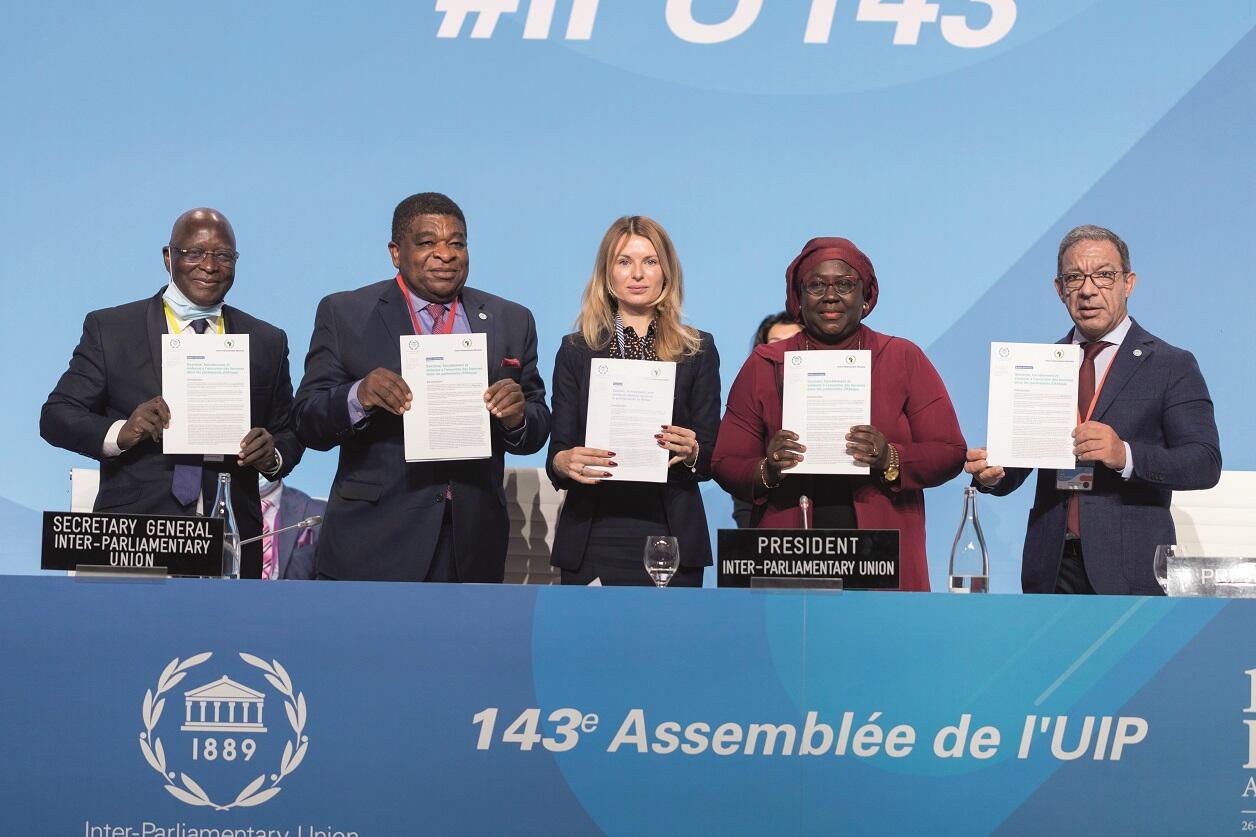 Launch of the IPU/APU study on Sexism, harassment and violence against women in parliaments in Africa during the 143rd IPU Assembly in Madrid. ©IPU/Spanish Parliament
Self-assessing gender-sensitivity
Between 2017 and 2021, we supported five parliaments in self-assessing their gender-sensitivity, a first step on the path to reform.
In Georgia, the self-assessment led to a debate on how the parliament could change the law to increase women’s parliamentary participation and prevent sexual harassment. Namibia’s self-assessment showed the prominence of wom- en in senior parliamentary positions and led to the creation of a group of women parliamentarians from both the parliamen- tary houses. In the United Kingdom, a gender-sensitivity audit raised awareness of violence against women in parliament.
Colombia’s parliament took immediate action to improve the working environment for women, including a campaign, Congreso En Igualdad, to sensitize MPs and the general pub- lic on representative equality. In Serbia, the Parliament has amended the electoral laws to introduce a quota, requiring at least 40 per cent of electoral candidates for parliamentary and local elections to be women.
Between 2017 and 2021, the number of caucuses of women parliamentarians grew from 81 to 112, an increase of 38 per cent. In the past five years, the IPU has supported such cau- cuses in Djibouti, Mauritania, Namibia, Serbia, Sierra Leone and Tanzania.
”A gender-sensitive parliament […] plays a relevant role in correcting inequalities and facilitating equal
participation of men and women. The IPU’s work to define gender-sensitive parliaments is particularly valuable.”
Claudia Mix Member of the Chamber of Deputies (Chile)
IPU Forum of Women Parliamentarians, November 2021
Combatting discrimination and violence against women
We continued and expanded our partnership with the United Nations Committee on the Elimination of Discrimination against Women (CEDAW), connecting the Committee with parliaments. We also called on parliaments to mainstream the CEDAW Convention into their national laws and oversee the elimination of gender-based discrimination.
Between 2017 and 2021, we organized 13 gender equality workshops for parliamentarians in Benin, Colombia, Djibouti, Georgia, Kenya, Mali, Namibia, Nigeria, Serbia, Sierra Leone, Tanzania, Turkey and the United Kingdom.
IPU support also enabled new legislation on violence against women in several countries. In Romania, MPs proposed an amendment to the Penal Code, eliminating the possibility for aggressors to be exempt from criminal responsibility when a victim’s complaint is withdrawn. A working group of MPs and civil society representatives reviewed the law on domestic violence to ensure conformity with obligations under the Istanbul Convention.
In Mauritania, the IPU helped the women’s parliamentary caucus to enhance the capacities of its members to advo- cate for legislation on gender-based violence and reproduc- tive health. Subsequently, the caucus succeeded in includ- ing the criminalization of sexual violence and female genital mutilation in both bills.
Georgia’s parliament adopted anti-harassment legislation after their 2018 self-assessment, supported by the IPU. In Djibouti, the IPU’s technical assistance led to new legislation on gender-based violence. And in Sierra Leone, the parlia- ment took steps to eliminate female genital mutilation, after the IPU helped build technical capacity and political support. A parliamentary caucus was established and is now driving parliamentary action on the issue with continued support from the IPU.
In 2021, we helped parliaments to introduce gender-sensitive responses to the COVID-19 pandemic. The online 2020 and in-person 2021 Summits of Women Speakers of Parliament also showcased good practices in this respect.
Étude de cas
Fighting sexism
The IPU Guidelines against sexism and gender-based violence in parliament created momentum and direc- tion that prompted several parliaments to use this re- source to develop and implement concrete measures. Between 2019 and 2021, at least 14 parliaments devel- oped new measures to address harassment and vio- lence against women in their own settings: Australia, Denmark, France (National Assembly), Ireland, Japan, Mexico (Senate), New Zealand, Norway, Republic of Korea, Sierra Leone, Switzerland, Uganda, United Kingdom and United States.
Measures include a comprehensive assessment of the situation, policies with complaint and investigation mechanisms, disciplinary sanctions against perpetra- tors, and the provision of confidential access to assis- tance for victims. The guidelines have also inspired the model anti-harassment policy of the Commonwealth Parliamentary Association and of the Assemblée par- lementaire de la Francophonie.
L’impact de l’UIP
Eliminating violence against women in parliament
IPU data shone a light on the levels of violence against women in parliament, a previously unexplored field of research. The IPU also offered solutions to help parliaments reduce violence against women MPs and parliamentary staff. Many parliaments have since put in place more stringent policies.