The year 2025 saw mixed progress on women’s overall representation in parliament, but a key development was the visibility and election of several women from historically disadvantaged groups, including women with disabilities, young women and women from indigenous communities, as shown in the IPU’s recently published Women in parliament in 2025 report.
United Kingdom: Towards a disability-inclusive parliament
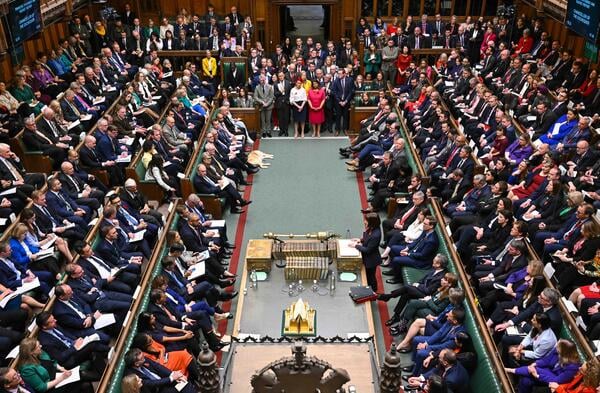
In 2025, the Parliament of the United Kingdom embarked on a critical journey – the House of Commons Modernization Committee, under the leadership of its Chair at the time, Lucy Powell, launched an inquiry into how to make Parliament more accessible for those with disabilities.
This was not an isolated occurrence. A year earlier, the chamber had elected the highest number of MPs with disabilities in its history – at least 13 of the elected MPs either have a disability or long-term physical and mental health concerns. Nine of the 13 were women, including Marie Tidball, an MP with a congenital disability.
Since her election, Ms. Tidball has been pushing for the Parliament to become more accessible. This was not only about parliamentarians, but as she highlighted in an interview with a news website, over a fifth of the voting-age population in the country is estimated to have a disability, and it is essential to ensure that Parliament’s composition reflects those numbers. It is also important to ensure that Parliament is inclusive for other people with disabilities who might come through the doors in the future.
This development from the United Kingdom underscores an essential aspect of representative politics – as more and more diverse representatives enter politics and parliaments, they also push these institutions to become more responsive to the needs of their wider communities. In short, parliaments that look like the people are best placed to serve the people.
Diverse women’s representation: Milestones to celebrate from around the world
In Australia, disability activist Ali France became the first woman with a disability to win a seat in the House of Representatives, and Marion Scrymgour became the first Aboriginal person to chair the House of Representatives as a member of the Speaker’s Panel. In Germany, Heike Heubach became the first deaf person to sit in the Bundestag. Twenty-one-year-old Julie Smejkalová became the youngest-ever person to be elected as an MP in Czechia’s history, while Charlotte Walker, who turned 21 on election day, became Australia’s youngest-ever Senator.
In Canada, the Prime Minister’s cabinet of 28 included three Indigenous ministers, two of whom were women. Mandy Gull-Masty was named the nation’s first Indigenous Minister of Indigenous Services and Rebecca Chartrand was named the Minister of Northern and Arctic Affairs as well as the minister responsible for the Canadian Northern Economic Development Agency. In the United Kingdom, MP Dawn Butler became the first Black woman appointed to the Panel of Chairs in Parliament.
Despite these wins, the path forward remains steeply uphill
While women remain a minority in most parliaments, women from historically disadvantaged groups and minority communities are often entirely absent. Several nations have been able to narrow the gender gap in their parliaments by using gender quotas and more gender-sensitive voting systems, but these policies rarely acknowledge – or therefore address – the multiple axes of disadvantage faced by women from underrepresented groups such as minority and/or Indigenous communities, young women and women with disabilities.
The path is further complicated by the fact that comprehensive and comparable data on the socio-economic and ethnic backgrounds of parliamentarians remains limited, making it difficult to map the disadvantages or track progress. As a consequence, this critical gap in representation persists stubbornly – and often invisibly – and women from disadvantaged backgrounds find themselves treading a much more rugged political terrain.
But it does not have to be this way
Ensuring equal participation and representation of women in all their diversity in parliaments is a matter of democratic justice but is also important for several reasons – from achieving genuine democracy and respecting human rights to attaining sustainable development and peace. But getting there requires intentional action – from an acknowledgement of the gaps to well-designed policies and interventions backed by sincere implementation.
An example of one such policy is the introduction of “nested quotas” i.e. a quota for women from specific groups within the larger gender quota, or gender requirements within diversity quotas. A few parliaments already have such policies in place – from India to Mexico and Zimbabwe. Ecuador’s Electoral Code mandates that young men and women should make up at least a quarter of all candidates (in addition to mandating parity among candidates on party lists). Not only did women comprise 45% of all MPs elected in 2025 in Ecuador (their highest representation in the country thus far), but three-quarters of the women elected were aged 45 years or younger. Ecuador’s diversity provisions extend to the leadership of the Parliament: four women sit on the National Assembly’s board (out of nine), including one Indigenous woman and one woman under 30.
In October 2025, the IPU Governing Council endorsed the IPU Plan of action for gender parity in parliaments. Among other guidelines, the plan lays down a set of recommendations that can help parliaments promote greater diversity. These include measures such as collecting and monitoring data on the representation of different groups; nesting diversity requirements within gender quotas and parity requirements within quotas or reserved seats for other groups; introducing campaign support that addresses multiple forms of discrimination; and creating diversity-sensitive parliaments.