Impact
The IPU facilitates parliamentary diplomacy and empowers parliaments and parliamentarians to promote peace, democracy and sustainable development around the world.


This sub-guideline is part of the guideline Project portfolio management. The main guideline should be read first for context and an overview.
This sub-guideline introduces an example of a project portfolio management (PPM) methodology that parliaments could implement to support their AI programme.
The STEP approach offers a structured way for parliaments to implement AI technologies and leverage their potential to enhance productivity and efficiency. Following this model allows parliaments to navigate the introduction of AI solutions with precision and foresight, ultimately driving positive outcomes and organizational success.
The STEP approach comprises four key stages:
These stages are shown Figure 1 and discussed in turn below.
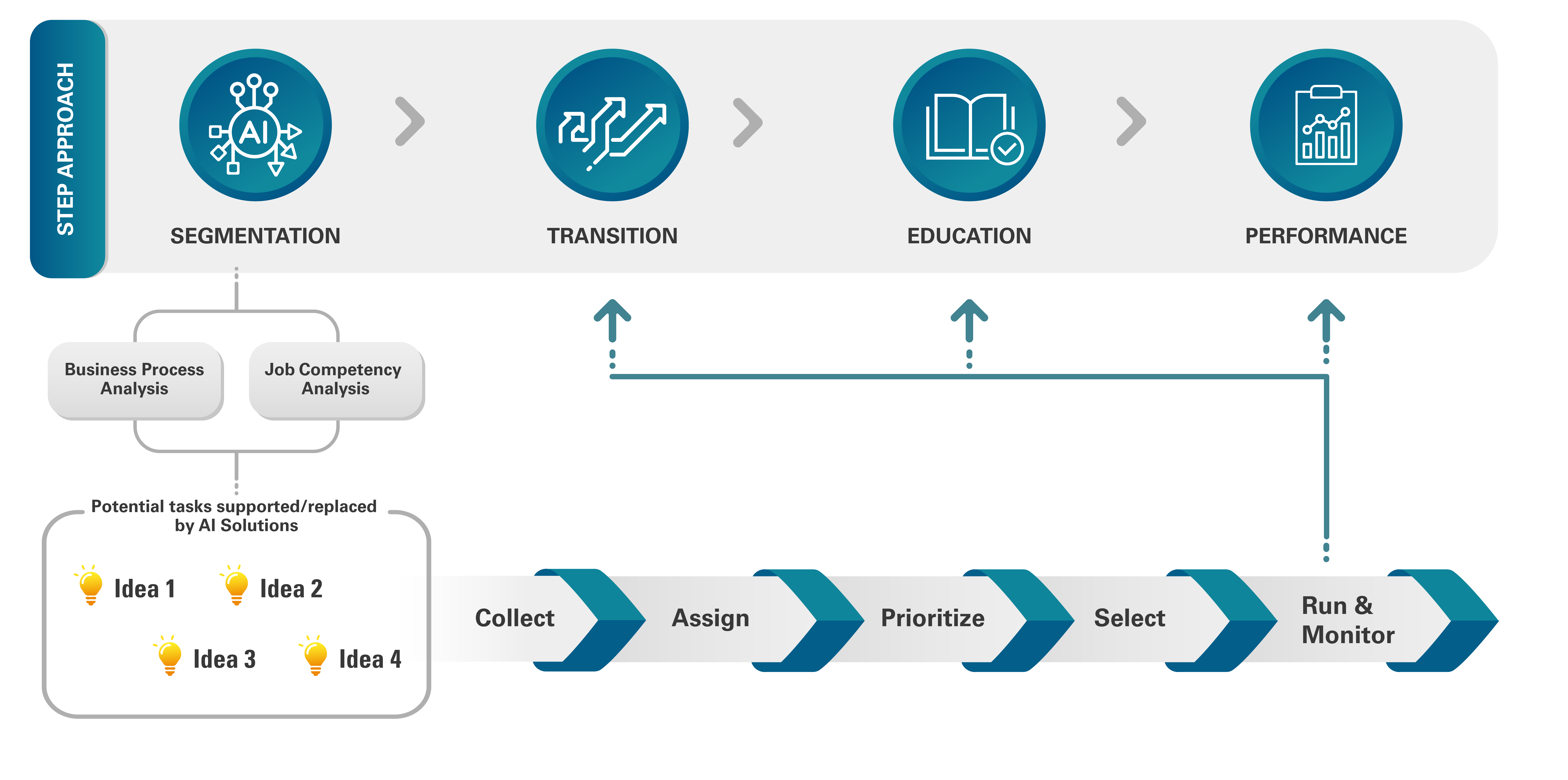
Segmentation
Segmentation offers a systematic framework for analysing activities within parliamentary proceedings by delineating related processes and tasks.
Segmentation entails categorizing tasks into three distinct types:
Crucially, this approach emphasizes that parliamentary staff should take the lead in task segmentation, leveraging their domain expertise to identify suitable tasks for AI integration. It also underscores the importance of staff experimentation with AI tools before widespread adoption, enabling them to assess suitability, usability and effectiveness in real-world contexts.
By adopting a proactive approach to task segmentation following a business analysis or a job competency analysis, parliaments can maximize the benefits of AI systems while ensuring alignment with organizational goals and priorities. Having a clear list of tasks identified for augmentation or automation will be crucial for the ideation phase. Within an AI PPM context, these tasks become the primary candidates for digital transformation.
Transition
The transition phase of the STEP approach focuses on changes to parliamentary staff members’ roles as tasks are augmented or automated through the integration of AI systems.
During this phase, resources freed up by AI implementation are carefully considered and assigned to one of three categories:
By strategically managing this transition, parliaments can optimize resource allocation, enhance staff productivity and capitalize on the transformative potential of AI technologies.
Education
In the context of parliamentary AI integration, education is a multifaceted approach aimed at fostering a culture of continuous learning and skill development, with a particular focus on embedding an ethos of AI learning into the organizational culture. As part of this, parliaments should frequently review and update learning materials to ensure they keep pace with evolving AI trends and best practices, as well as revisiting the segmentation process regularly to identify new opportunities for AI integration.
Parliamentary staff can be enrolled on certifying courses that teach them the necessary knowledge and skills to effectively leverage AI solutions in their roles. These skills could include fine-tuning documents or data priority from the organization, mastering prompt engineering to create effective commands or prompts for AI systems, and evaluating the validity of predictions made by these systems.
Performance evaluation
The performance evaluation phase acknowledges that the introduction of AI systems in parliaments represents a shift rather than just a lift in operational dynamics. Performance evaluation encompasses the following aspects:
The STEP approach provides a structured and adaptable AI PPM method for parliaments. It helps ensure alignment with organizational goals, optimizing resource allocation and maximizing the overall impact of AI investments. By adopting this approach, parliaments can navigate the complex landscape of AI projects with confidence, driving innovation, efficiency and effectiveness in legislative processes and governance.
The Guidelines for AI in parliaments are published by the IPU in collaboration with the Parliamentary Data Science Hub in the IPU’s Centre for Innovation in Parliament. This work is licensed under a Creative Commons Attribution-NonCommercial-ShareAlike 4.0 International licence. It may be freely shared and reused with acknowledgement of the IPU. For more information about the IPU’s work on artificial intelligence, please visit www.ipu.org/AI or contact innovation ipu [dot] org.