The IPU facilitates parliamentary diplomacy and empowers parliaments and parliamentarians to promote peace, democracy and sustainable development around the world.
We help parliaments build peaceful and inclusive societies, fight terrorism and violent extremism and curb the proliferation of weapons of mass destruction.
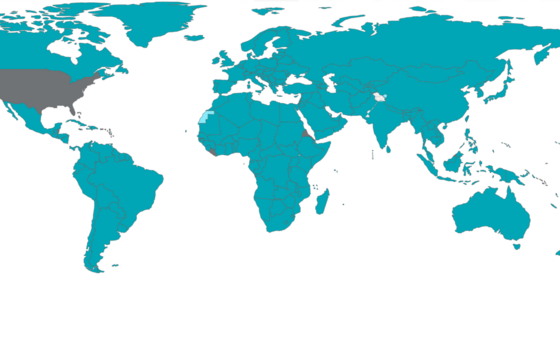
Nearly every country in the world has some form of parliament. Parliamentary systems fall into two categories: bicameral and unicameral. Out of 189 national parliaments in the world, 82 are bicameral (164 chambers) and 107 are unicameral, making a total of 271 chambers of parliament with nearly 45,000 members of parliament. IPU membership is made up of 184 national parliaments
Throughout the year, the IPU and its Members organize many events for parliamentarians to exchange good practices, acquire the latest information and identify avenues for action.
The IPU has been collecting data on parliaments since its inception in 1889, including information on women’s participation in politics since 1945. In this section, discover the IPU's knowledge bank for and about parliaments.
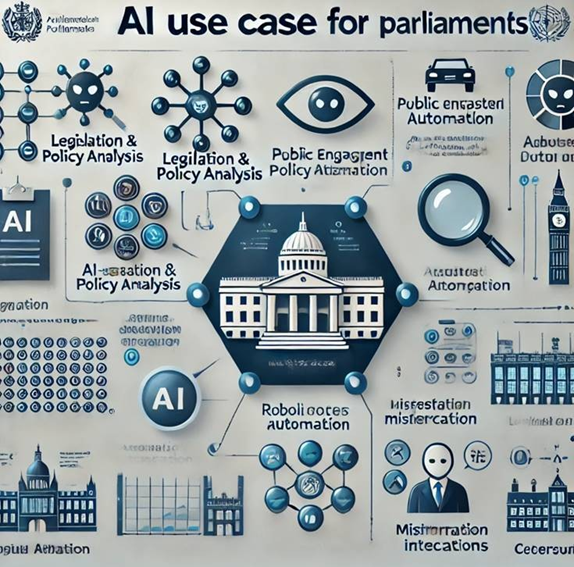
As artificial intelligence (AI) continues to reshape industries worldwide, parliaments are increasingly exploring its potential to enhance governance. An AI Use Case Map serves as a strategic guide to understanding and implementing AI-driven solutions across legislative functions, which categorizes AI capabilities into key parliamentary functions.
A visual representation of an AI Use Case Map offers a number of key advantages, especially when communicating complex information to diverse audiences. Here are several benefits:
Enhanced Clarity. Visuals make it easier to grasp the overall structure and key concepts at a glance, reducing cognitive load compared to dense text.
Holistic Overview. A map or infographic-style layout provides a bird’s-eye view of all use cases, helping viewers understand interdependencies and common themes.
Faster Information Absorption. Images, icons, and colour coding let stakeholders quickly identify relevant sections or areas of focus, saving time and increasing efficiency.
Improved Stakeholder Engagement. A well-designed visual is more inviting and engaging, encouraging a broader range of stakeholders—technical and non-technical alike—to interact with the information.
Better Communication & Collaboration. Visual representations serve as a shared reference point, making it easier for cross-functional teams (e.g., legislators, policy advisors, technologists) to discuss and align on priorities.
Highlighting Key Insights & Priorities. Graphics can be used to emphasize the most impactful or time-sensitive AI opportunities, guiding decision-makers toward critical areas first.
Greater Retention & Recall. People are more likely to remember information presented visually. A use case map can become a go-to resource for ongoing discussions and strategic planning.
Supports Strategy & Roadmap Development. By visually mapping out current and future AI use cases, Parliaments can plan systematically, identifying gaps and long-term goals.
Overall, a visual use case map makes AI concepts and opportunities more accessible, fosters collaboration, and drives more effective decision-making within Parliaments.
This webinar will introduce some practices in three parliaments having developed such an approach.
Panelists:
Martin Kamprath, Scientific Advisor and Expert for Energy, Digitalisation, Mobility, Bundestag, Germany
Christopher Henry, Director General, Digital Business Enablement and Innovation, House of Commons, Canada
Peter Reichstädter – CIO / Head of ICT Strategy Department, Austrian Parliament
If you want to avoid having AI-generated use case map for your Parliament that looks like the one below, come and join this discussion!
Language(s): English, French
The event is part of the Transforming Parliaments webinar series.