
Impact
The IPU facilitates parliamentary diplomacy and empowers parliaments and parliamentarians to promote peace, democracy and sustainable development around the world.



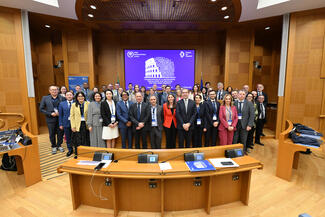
The 2026 in-person meeting of the IPU Centre for Innovation in Parliament (CIP) Parliamentary Data Science Hub at the Chambers of Deputies of Italy. © IPU CIP
The 2026 in-person meeting of the IPU Centre for Innovation in Parliament’s (CIP) Parliamentary Data Science Hub took place at the Chamber of Deputies of Italy in Rome on 13–15 May 2026.
Co-organized by the CIP, the Italian Chamber of Deputies and the Chamber of Deputies of Brazil, the meeting was attended by senior officials from 23 parliaments from Africa, the Americas, Europe and the Middle East.
The meeting’s principal objectives were to reflect honestly on progress on AI in parliaments over the preceding 12 months, including obstacles and failures as well as successes, and to shift the focus of community discussion from strategy and theory to practical implementation.
Download the full report of the meeting: Implementing AI in parliaments: Taking stock and planning the next steps together
The meeting was timely, as preliminary data from the upcoming World e-Parliament Report 2026 shows that 88% of parliaments now report using AI, yet governance, capacity and culture are struggling to keep pace with adoption of the technology.
The discussion over three days revealed a consistent picture: AI adoption is outpacing AI governance. Use is often informal and undeclared. However, shadow AI – whereby staff and MPs use their own, unsanctioned tools – is less a problem to be stamped out than a signal that officially supported tools are not meeting users’ needs. Several parliaments reported that it was more effective to offer supported alternatives than to try to prohibit unsupported tools. In a related challenge, the phenomenon of members buying AI tools themselves is leaving some institutions holding procurement responsibilities they never anticipated.
Capacity, rather than funding, is the bottleneck holding most parliaments back. Very few parliaments have created dedicated AI roles; most are simply layering AI governance and support onto existing jobs. What seemed to help was naming five functions explicitly – user, decision maker, coordinator, product owner and enabler – so that responsibility does not fall through the cracks. None of these need to become new job titles, but each needs an owner.
AI adoption succeeds when the focus is on process, education and culture rather than the technology itself. A longer-term concern is emerging, too: as AI takes over tasks that previously helped junior staff build institutional knowledge, parliaments will need to find new ways to pass that knowledge on.
Underneath all of this sits data governance, which several participants described as the layer on which everything else depends. Privileged and unstructured material, as well as emails, working drafts and anything not cleanly categorized: these are the types of data that carry the greatest risk. Institutions can become legally responsible for data they do not control in practice. The approach that seemed to work best was an iterative one: starting small by governing one limited data set properly, then expanding gradually across parliament.
Sovereignty emerged as a distinct theme. Absolute technological independence is not realistic or even desirable. It is more useful to frame sovereignty around managing dependency: leaning on commercial models where it makes sense to do so while applying stricter requirements to more sensitive data. There was also a timely warning from one participating parliament which had seen a commercial AI model switched off with little warning, highlighting the fact that parliaments need clear sight not only of their data, but also of the models on which the data relies.
Agentic AI was seen as the next frontier, and a genuinely harder governance problem than current generative AI tools, since these systems act autonomously across multiple steps. The risks raised – including prompt injection, tool abuse and data leakage – do not map cleanly to existing frameworks. The point repeated most often was that process redesign must come before agents are introduced; bolting agents onto existing workflows can amplify weaknesses that are already there.
The meeting produced a number of recommendations to support adoption of AI. These span the whole AI journey, from foundational to advanced, though all of them remain relevant regardless of an institution’s current level of AI maturity:
AI should be treated as a governed institutional capability rather than a loose collection of tools. In practice, this means cross-functional governance with real authority delegated from senior leadership, not just guidance documents. That governance has to rest on solid information management: unify data, records and knowledge management systems before scaling AI tools, and prove value on a small, well-governed data set before expanding, rather than attempting everything at once.
Literacy training, peer networks and direct engagement with MPs and staff all matter more than is often assumed, and early failures should be treated as learning opportunities rather than as grounds to pull back. On shadow AI specifically, the lesson is to compete with it rather than ban it: offer trusted, governed alternatives, complete with the guidelines and support that make them genuinely usable. For sovereignty, the practical advice is to map dependencies, build out disruption scenarios and treat workload portability as a core capability, aiming for pragmatic autonomy rather than ideological purity.
For agentic AI, governance frameworks need to be in place before deployment, not after. Process redesign, human-in-the-loop controls and independent oversight all need to exist upfront. Parliaments could benefit from exploring shared infrastructure models rather than each institution building its own.
The meeting identified themes for future work, including: further development of the AI literacy and training agenda; continued exploration of dedicated AI roles and competency frameworks; the sharing of approaches to AI sovereignty and dependency management; and the development and sharing of practical guidance on agentic AI governance.
The CIP provides resources to support parliaments in their transition to AI, regardless of their stage of maturity, including the Maturity Framework for AI in Parliaments, the Guidelines for AI in parliaments and the Use cases for AI in parliaments.