Impact
The IPU facilitates parliamentary diplomacy and empowers parliaments and parliamentarians to promote peace, democracy and sustainable development around the world.

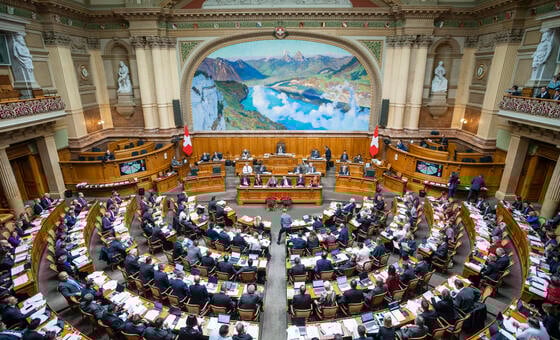
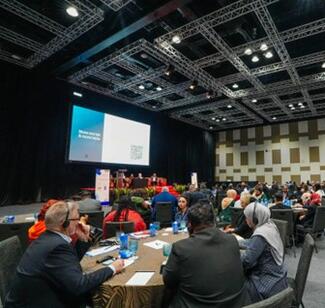
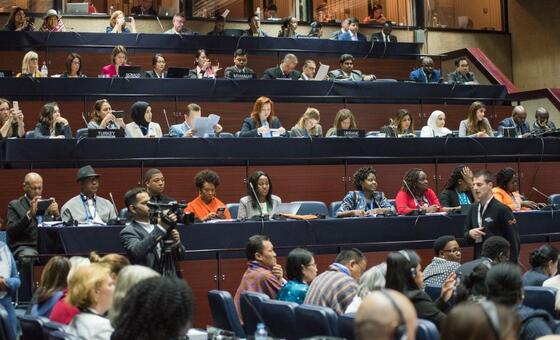
The AI in Parliament track on day two of the conference (credit: IPU CIP)
Insights from the AI In Parliaments track at the conference The Role of Parliament in Shaping the Future of Responsible AI, held from 28 to 30 November 2025 in Kuala Lumpur, Malaysia.
Parliaments worldwide are navigating uncharted territory together. Yet what emerged in Kuala Lumpur was that beneath this uncertainty lies a surprising consensus about what matters most.
A poll of participants revealed where parliaments stand in their use of artificial intelligence (AI). None claimed to have reached advanced practice or global standard-setting. Most were clustered in the early stages – using AI informally without policies, experimenting with basic tools or running pilot projects. Yet these parliaments clearly understood not just the technology but also the organizational foundations required for success.
The primary barrier to successful AI adoption is often not technology or resources, but the gap between technical expertise and political leadership. As one delegate put it: “There’s a complete disconnect between the political side and our administrative staff side, where a lot of work has been done, but there is just no communication.” IT departments build capabilities that members do not use, members articulate needs that technical teams do not understand, and strategies get approved but never translate into action.
This disconnect plays out differently across contexts. The House of Representatives of New Zealand showcased mature implementation of Hansard transcription, yet emphasized that human oversight remains essential. The Chamber of Deputies of Chile demonstrated innovation in regulatory analysis while being frank about resource constraints: “Technological innovation is not the first thing in parliament”. Meanwhile, the National Assembly of Mauritius has achieved 98% paperless operations and is building Creole language models through university partnerships. Each parliament’s journey is unique, but all face the same organizational challenge: bringing political vision and technical capability into alignment.
Mr. Lorenzo Manelli, Director-General for Information Technologies and Cybersecurity at the European Parliament, described how the European Union AI Act has provided clarity by requiring transparency, documentation and accountability from project conception. But his fundamental point was about progression from digitization (converting physical archives) through digitalization (modernizing current processes) to digital transformation (leveraging advanced tools such as AI). Steps cannot be skipped. As participants repeatedly emphasized, “beautiful AI applications require beautiful underlying data”.
Mr. Nophadol In-na, a member of the Senate of Thailand, reinforced this point with practical experience. The Senate Intelligence Center has integrated data systems, AI-driven search and workflow visualization, but only after having aligned its digital parliament master plan with the national AI strategy. Mr. In-na noted that, when he first introduced AI to senior senators, “it was very difficult to convince them”. The solution was to hold multiple workshops where senior members saw colleagues using AI successfully.
Solutions emerged across the sessions. Successful parliaments establish cross-functional working groups spanning IT, legal, policy and member offices, treating AI as an institutional challenge rather than a technical project. They identify political champions who can drive adoption from within, and they empower younger staff who understand the technology better, challenging traditional parliamentary hierarchies.
The European Parliament began its first generative AI project with one staff member (age 62, dispelling stereotypes) working with a four-digit budget. This “start small, learn fast” principle resonated across contexts. Critically, Mr. Ludovic Delepine from the European Parliament spoke about task segmentation opening new collaboration pathways: while parliamentary processes differ dramatically, individual tasks – summarizing, translating and searching – are universal. Parliaments can share task-specific tools and adapt them locally rather than building complete bespoke systems.
While funding constraints emerged as a concern for many, the IPU Centre for Innovation in Parliament’s (CIP) experience shows that money and resources follow vision and strategy. The real constraint, participants acknowledged, is capacity: training, knowledge and cultural change. Technology can be purchased as a service, but capacity must be built internally. MPs and staff need training and peer support to become AI-literate.
Mr. In-Na articulated why members must lead on ethical AI use: “As lawmakers, we should be the first people who use AI with ethics.” MPs are not just consumers of AI tools: they are role models for constituents and legislators crafting AI regulation. Ethical leadership is not aspirational but existential for democracy.
The conference revealed parliaments united by common challenges despite vastly different contexts. The IPU’s newly launched Maturity Framework for AI in Parliaments offers a diagnostic road map, while the CIP networks connect over 50 parliaments for peer learning and exchange. Success depends less on technical sophistication than on building internal consensus, establishing cross-functional coordination, and maintaining the fundamental principle that AI must augment human judgement, never replace it.