Impact
The IPU facilitates parliamentary diplomacy and empowers parliaments and parliamentarians to promote peace, democracy and sustainable development around the world.


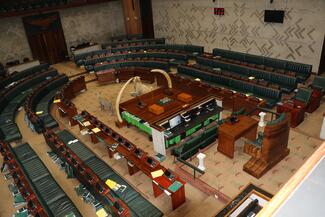
Chamber hall of the National Assembly of Zambia (credit: NA Zambia)
The National Assembly of Zambia has pioneered a distinctive approach to digital transformation that puts elected representatives at the centre of technological change. The Parliamentary Reforms and Modernisation Committee demonstrates how parliamentary modernization can succeed when driven by the people who will actually use the technology.
The Committee, which is composed entirely of MPs, serves as both a forum for strategic planning and a bridge between democratic goals and technological capabilities. By placing parliamentarians at the centre of decision-making, this approach avoids the twin pitfalls of top-down mandates and technology-for-technology’s-sake solutions. The structure aligns with good practices outlined in the Guide to digital transformation in parliaments, published jointly by the Inter-Parliamentary Union and the Association of Secretaries General of Parliaments, which emphasizes the critical importance of member ownership in modernization efforts.
During regular meetings, Committee members engage in substantive discussions about the National Assembly’s technological vision. These discussions focus on a key question: how can digital tools strengthen parliamentary functions, improve public access and enhance democratic participation? This deliberative model ensures that technology serves democratic purposes rather than becoming an end in itself. Through its consultative approach, the Committee facilitates input from various stakeholders, making parliament’s modernization efforts more inclusive.
Increased ownership and continuity
The Committee addresses two of the most persistent challenges in parliamentary modernization: securing resources and maintaining momentum. Digital transformation requires significant financial investment and sustained commitment across multiple budget cycles. When MPs participate directly in planning and decision-making, they develop a deeper understanding of both costs and benefits, making them more effective advocates for the necessary funding. This ownership creates institutional continuity that survives changes in administration and political leadership – something particularly important for parliaments, like the National Assembly of Zambia, that are establishing a digital transformation culture for the first time.
The Committee’s role extends beyond budget advocacy to hands-on project governance. Its members evaluate proposed IT initiatives and provide early feedback that shapes development priorities. This process serves as a crucial change management mechanism, ensuring that technological solutions align with actual parliamentary needs and MPs’ expectations. Moreover, the involvement of parliamentarians at an early stage helps to avoid the common pitfall of IT departments developing systems that work technically but do not meet user requirements. When MPs can provide input on proposed features, the results are more likely to be both functional and relevant
When combined with agile methods, MPs’ input becomes particularly valuable for rapid iterations and continuous improvement. Parliamentarians appreciate being part of this iterative process, which allows them to see how their feedback directly translates into system enhancements and feature modifications. This immediate responsiveness creates a positive feedback loop that encourages continued engagement and more detailed input.
Most importantly, the Committee facilitates ongoing dialogue between IT staff and parliamentarians, transforming what could be a transactional relationship into a collaborative partnership. IT staff gain direct insights into MPs’ priorities and working patterns, while parliamentarians develop technical literacy that enables more informed decision-making about digital initiatives. For example, the Committee recently explored how AI might enhance parliamentary work, revealing valuable insights into expectations and levels of understanding on both sides of the politics–technology divide.
The experience of the National Assembly of Zambia offers valuable lessons for other parliaments navigating digital transformation. By putting MPs at the centre of modernization planning, the Committee ensures that technology serves parliament while building the institutional commitment needed for long-term success. The model demonstrates that effective parliamentary modernization happens not when technology leads and politics follows, but when parliaments integrate digital tools to strengthen their core functions.