Impact
The IPU facilitates parliamentary diplomacy and empowers parliaments and parliamentarians to promote peace, democracy and sustainable development around the world.

By Mr. Sujeet Kumar, member of the Rajya Sabha of India
There is an old saying: “lost in translation”. But on the day I stood on the floor of the House and took my oath in Odia, my mother tongue, something was found. It was not merely a personal moment; it was a tribute to every person in Odisha who had placed their trust in a representative to carry their voice into those halls. One by one, the members who followed raised their voices in Kannada, Tamil, Bengali, Marathi – each oath a small act of belonging.
What made this possible was the infrastructure working behind the scenes: the Parliament of India has deployed simultaneous interpretation across all 22 of the country’s scheduled languages, ensuring that every oath, debate and recorded intervention is understood and preserved in the official record.
This is the animating principle behind the country’s parliamentary AI agenda: language inclusion as digital public infrastructure – comparable in ambition, if not yet in scale, to Unified Payments Interface (UPI), the payments platform processing around 650 million transactions daily, or to Aadhaar, the biometric identity system covering every resident.
The Parliament of India is one of the most linguistically diverse legislative bodies in the world. Parliamentary business papers were historically available only in Hindi or English; AI has changed that. The Secretariat now publishes daily agenda papers in 12 languages, accessible in real time via the Digital Sansad portal.
For MPs and ministers, AI functions as a research tool, sifting through thousands of documents to surface the most relevant facts for a debate. For ministers fielding parliamentary questions, the system synthesizes complex departmental reports into data-backed briefings, supporting the principle of executive accountability to the legislature that is central to the Indian parliamentary model.
The translation infrastructure rests on Bhashini, an AI-powered language platform developed by the Ministry of Electronics and Information technology (MeitY) that enables real-time multilingual access to parliamentary proceedings. Supplementing it is AIKosh, a specialized data set being trained on the corpus of Indian parliamentary speeches and debates to make translations progressively more accurate for legislative language.
In collaboration with Bhashini, the Secretariat has built an AI-driven verbatim transcription system that will run alongside traditional reporting from the upcoming session. The Secretariat and MeitY have also signed a memorandum of understanding to launch Sansad Bhashini, which will open archives of parliamentary debates and records to parliamentarians, researchers and the public across multiple languages.
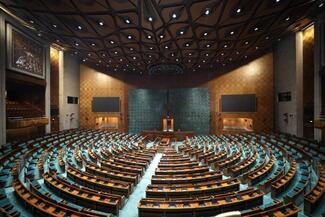
Through the Sansad app and an integrated AI-driven dashboard, the new parliament building is moving towards becoming a paperless environment in which MPs can access real-time debates, digital libraries and constituency tools across languages. The digital ecosystem encompasses everything from house business schedules to MP-led tours, consolidating parliamentary resources into a single, multilingual platform.
The practical effect of these developments is that the voices of constituents from every linguistic background are not just heard in the chamber, but also recorded, archived and made accessible. As the system matures, Sansad Bhashini has the potential to redefine what participation in Indian democracy looks like, reinforcing the principle that democratic representation is about not only the right to vote, but also the right to be understood.