
Impact
The IPU facilitates parliamentary diplomacy and empowers parliaments and parliamentarians to promote peace, democracy and sustainable development around the world.



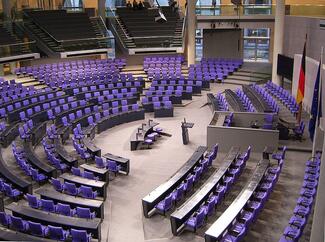
Plenary hall of the German Bundestag (credit: Creative Commons)
When it comes to the adoption of artificial intelligence (AI), all parliaments face the same dilemma: while the technology offers transformative potential, conversations all too often become technical and laden with jargon, or focus too narrowly on very specific areas of parliamentary business. The myriad critical support services that exist across institutions can be overlooked, with the possible result that different departments have different expectations of AI and speak different languages. This situation risks creating silos that prevent strategic coordination and limit the potential for comprehensive implementation.
Critically, without proper AI governance frameworks, institutions risk deploying AI solutions that conflict with democratic values and the ethical principles that are fundamental to parliamentary democracy.
The AI Cloverleaf Model, developed by the German Bundestag, provides a potential solution. It is a comprehensive AI governance framework that translates the possibilities of AI into practical, department-specific opportunities while ensuring that relevant checks and balances are in place – and, therefore, that the institution remains aligned with democratic values and ethical principles.
Developed through extensive research, the model organizes parliamentary AI applications into three intersecting domains:
Mr. Martin Kamprath, AI Coordinator at the German Bundestag, describes this model as “refreshingly practical”. Its power lies in its central intersection, showing how cross-departmental AI applications can serve multiple functions simultaneously – since text-processing, information retrieval and analytical tools benefit virtually every parliamentary operation. This allows parliaments to realize economies of scale and develop shared learning opportunities. The framework enables coordinated strategy development and resource optimization, while lessening the risks that arise when departments develop their own solutions in isolation.
Working within existing organizational structures, departments collaboratively map their specific tasks and processes. Using digital collaboration tools, teams identify concrete AI applications at the task level – where implementation occurs. This participatory approach ensures buy-in across parliament while maintaining institutional knowledge and respecting departmental expertise. By applying this framework, the German Bundestag has already identified over 180 systematically developed AI use cases.
Parliaments cannot afford fragmented AI adoption without proper governance and oversight. The AI Cloverleaf Model therefore serves as a valuable solution for other legislatures, offering strategic clarity and a governance structure to support confident and considered AI integration. It transforms abstract AI potential into actionable departmental road maps while ensuring institutional coherence and adherence to democratic values throughout the implementation process.
Further reading
For a more detailed overview of the methodology and for implementation guidance, see: The AI Cloverleaf Model: Mapping AI Use Cases in Parliaments, by Mr. Martin Kamprath, AI Coordinator & Researcher at the German Bundestag.