
Impact
The IPU facilitates parliamentary diplomacy and empowers parliaments and parliamentarians to promote peace, democracy and sustainable development around the world.





This sub-guideline is part of the guideline Strategic actions towards AI governance. Refer to the main guideline for context and an overview.
This sub-guideline provides guidance and recommendations on AI strategy and innovation for parliaments.
The journey towards effective AI governance begins with an understanding of its importance. AI governance is about more than simply managing new technology: it is about creating a framework that maximizes the benefits of AI while minimizing its risks.
By taking a strategic approach to AI governance, parliaments can build a robust AI ecosystem that balances operational needs with innovation and ethical considerations.
Key points:
Once the foundations are established in terms of strong governance and an AI code of ethics, and once robust engagement with key stakeholders has identified where AI can add value to the work of parliament, it is time to turn to developing an AI strategy grounded in this work.
An AI strategy is a comprehensive plan that outlines how parliament will use AI to achieve its goals and address challenges. It can be part of parliament’s broader strategy or a specific document that is aligned with this strategy. It is a corporate-level strategy that has goals which depend on AI, not a technology strategy. The main aim is to develop a road map for AI solutions that is aligned with business needs.
Focusing on parliament’s goals, an AI strategy encompasses AI systems and the requirements for developing, deploying or purchasing them, with consideration given to ethical principles, as well as to regulatory and legislative issues. Base requirements to drive the strategy forward include workforce planning and infrastructure.
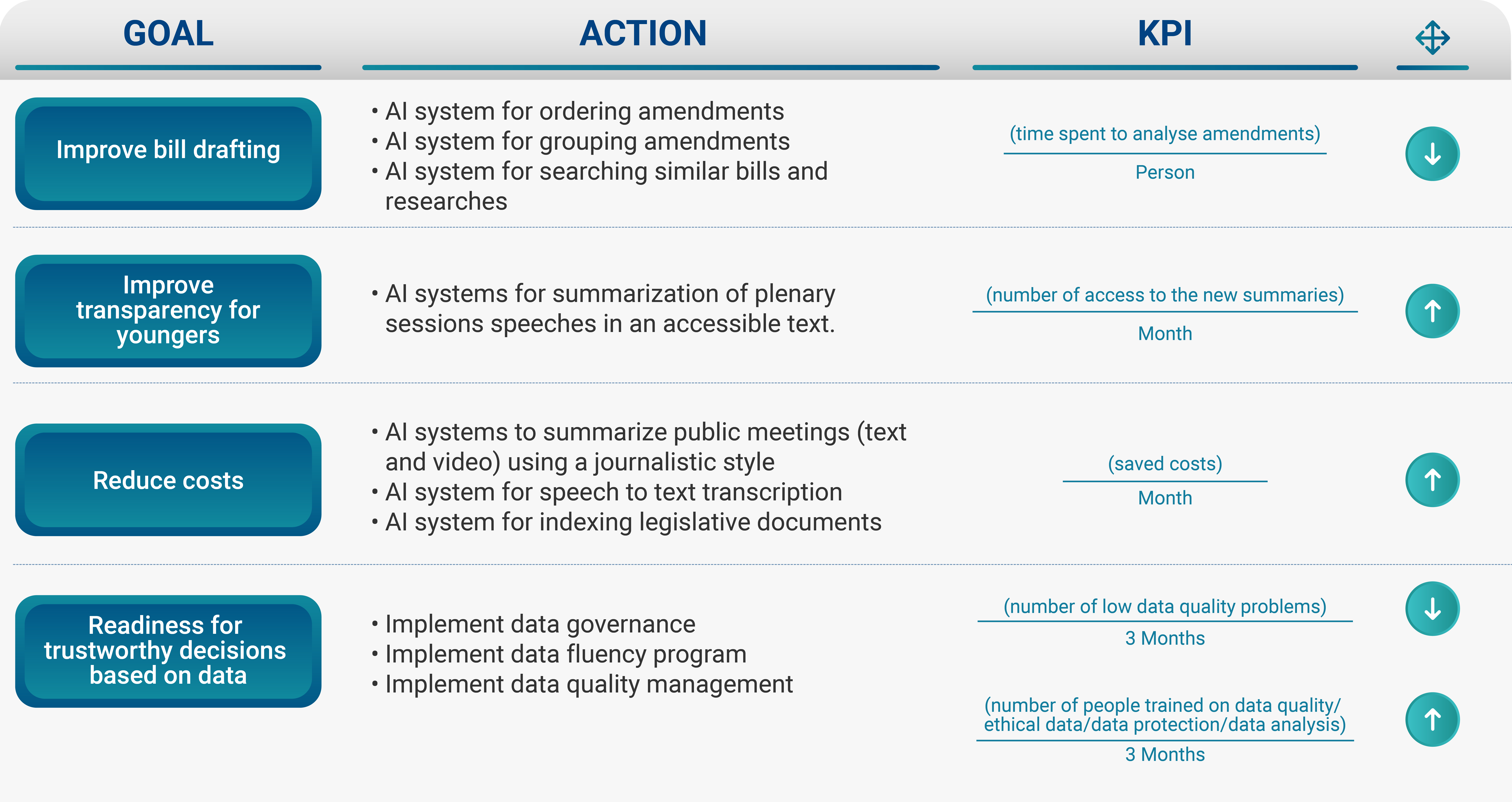
As a high-level document prepared for, and agreed by, senior parliamentary leaders, an AI strategy should use business language and arguments for business decision makers. Many senior managers will therefore already be familiar with its format and structure, and parliament should adopt a structure and approach it already uses, if appropriate. Alternatively, parliament can follow the sample structure outlined below and illustrated in Figure 1 (below):
Vision
Formulate a clear vision statement indicating what parliament’s needs are for AI. The nature of this statement will depend on whether the AI strategy is a stand-alone document specific to AI, or if it is integrated into a broader parliamentary strategy. In the latter case, there should be a single, overarching vision.
Goals
Include measurable goals that parliament can achieve using AI systems. These goals can focus on processes, practices and resources aimed at improving or driving AI adoption or mitigating AI-related risks.
Actions or drivers to achieve the goals
Detail specific projects and initiatives that will be implemented to achieve the stated vision and goals. These projects can affect multiple goals at once. Likewise, a single goal can be impacted by multiple projects. Projects can directly address business needs, prerequisites for business needs, or processes and practices to mitigate risks.
Key performance indicators (KPIs)
State what metrics will be used to measure progress towards the goals. It is often useful to set a target for each KPI.
Risks
Identify the main risks associated with the inappropriate use of AI, which can justify specific actions within the strategy.
An agile approach enables rapid iteration and continuous improvement, making it a practical way to work when innovating with new technologies such as AI:
Managing change
Adopting rigorous change management practices within the iterative development process helps parliaments to manage resistance and ensure the smooth adoption of AI technologies. It is essential to develop a clear change management plan and to transparently communicate the goals of AI adoption, as well as the technology’s impact on the organization, its staff and members. By understanding and carefully navigating the traditionally conservative culture of parliament and demonstrating clear, tangible benefits from the adoption of AI, it is possible to foster innovation and drive successful AI initiatives.
AI, as a new technology with immense potential, is very much about innovation. A good AI governance regime will include ways to promote innovative practices, taking a strategic and nuanced approach.
The first step is to build a strong case for AI by clearly articulating its benefits and focusing on how it can address specific business needs and challenges. Demonstrating successful AI implementations in similar organizations through data and case studies can be persuasive. Likewise, selecting projects with a high likelihood of success can build confidence and show the value of AI.
Starting with small, manageable pilot projects that have clear objectives and measurable outcomes is crucial. This approach builds knowledge and experience, helps to develop familiarity and trust in AI-based systems, and can demonstrate potential, serving as a catalyst for further innovation. Of course, because pilots are also about experimenting and testing ideas, it is important to accept that some will inevitably fail. In other cases, it may be determined that the pilot is not worth pursuing. Building a reflective learning process into the innovation cycle will help parliaments to realize value and learn lessons as they go.
Innovation can be supported through the following approaches:

The Guidelines for AI in parliaments are published by the IPU in collaboration with the Parliamentary Data Science Hub in the IPU’s Centre for Innovation in Parliament. This work is licensed under a Creative Commons Attribution-NonCommercial-ShareAlike 4.0 International licence. It may be freely shared and reused with acknowledgement of the IPU. For more information about the IPU’s work on artificial intelligence, please visit www.ipu.org/AI or contact innovation ipu [dot] org.