
Impact
The IPU facilitates parliamentary diplomacy and empowers parliaments and parliamentarians to promote peace, democracy and sustainable development around the world.




This guideline is intended for a diverse audience within parliaments, including staff and MPs without prior AI expertise, senior staff responsible for AI implementation, decision makers at various levels (particularly those responsible for training and staff development budgets), users of parliamentary technologies, and technical staff involved in AI production and procurement.
This guideline focuses on the importance of awareness-raising and training for both data literacy and AI literacy in parliaments. It outlines the need for a comprehensive training programme tailored to different roles within parliament, including decision makers, users, technical staff and MPs, providing detailed recommendations for training content in both areas.
The AI literacy sub-guideline includes the fundamentals of AI, machine learning basics, ethical implications and practical applications in governance. The data literacy sub-guideline, meanwhile, encompasses topics such as data management principles, data collection, cleaning and analysis, and ethical considerations.
This guideline stresses the importance of understanding AI’s potential benefits and risks in a parliamentary context, as well as the ethical considerations involved. It also highlights the need for a multidisciplinary approach and the development of a data-driven culture within parliaments.
Overall, this guideline provides guidance for parliaments on building capacity and preparing their staff for the effective and responsible use of AI technologies.
The transformative potential of AI in parliaments necessitates comprehensive staff preparation and training. All parliamentary staff – from technical implementers to end users – will benefit greatly from understanding AI in general and, more specifically, its impact on their roles. Knowledge of the related ethical considerations and complexities is also important.
By strategically building staff skills and capabilities, parliaments can maximize the benefits of AI while effectively managing its risks, avoiding both overestimation of AI’s impact and underestimation of its challenges.
Given that AI systems rely on data, parliamentary training programmes should cover both AI literacy and data literacy – since good-quality, well-managed and understood data is at the heart of successful AI implementations. It is important for parliaments to start developing these programmes before working with AI.
What is data literacy?
Data literacy is the ability to read, understand, create and communicate data as information. It involves understanding how to effectively collect, analyse, interpret and present data in meaningful ways. Data literacy includes knowing where data comes from, and grasping basic statistical concepts and data presentation and visualization techniques. Data literacy is vital for critically evaluating data-driven arguments and conclusions.
What is AI literacy?
AI literacy is an understanding of the basic principles, capabilities and limitations of AI – something that is crucial for informed decision-making about AI adoption and oversight in parliaments. It involves the ability to recognize AI applications, grasp fundamental concepts like machine learning and data analysis, and critically evaluate AI’s potential impacts. An AI-literate workforce can better leverage AI to enhance parliamentary functions while identifying and mitigating risks, ensuring responsible AI use that aligns with democratic principles.
A more advanced level of AI literacy encompasses a deep understanding of the following:
Data readiness is a prerequisite for AI readiness in parliaments and requires multidisciplinary working teams across the product portfolio and throughout the system’s life cycle. It is important for all AI initiatives to consider data governance and management processes and, as Figure 1 below shows, for data literacy to be a prerequisite for AI literacy training.
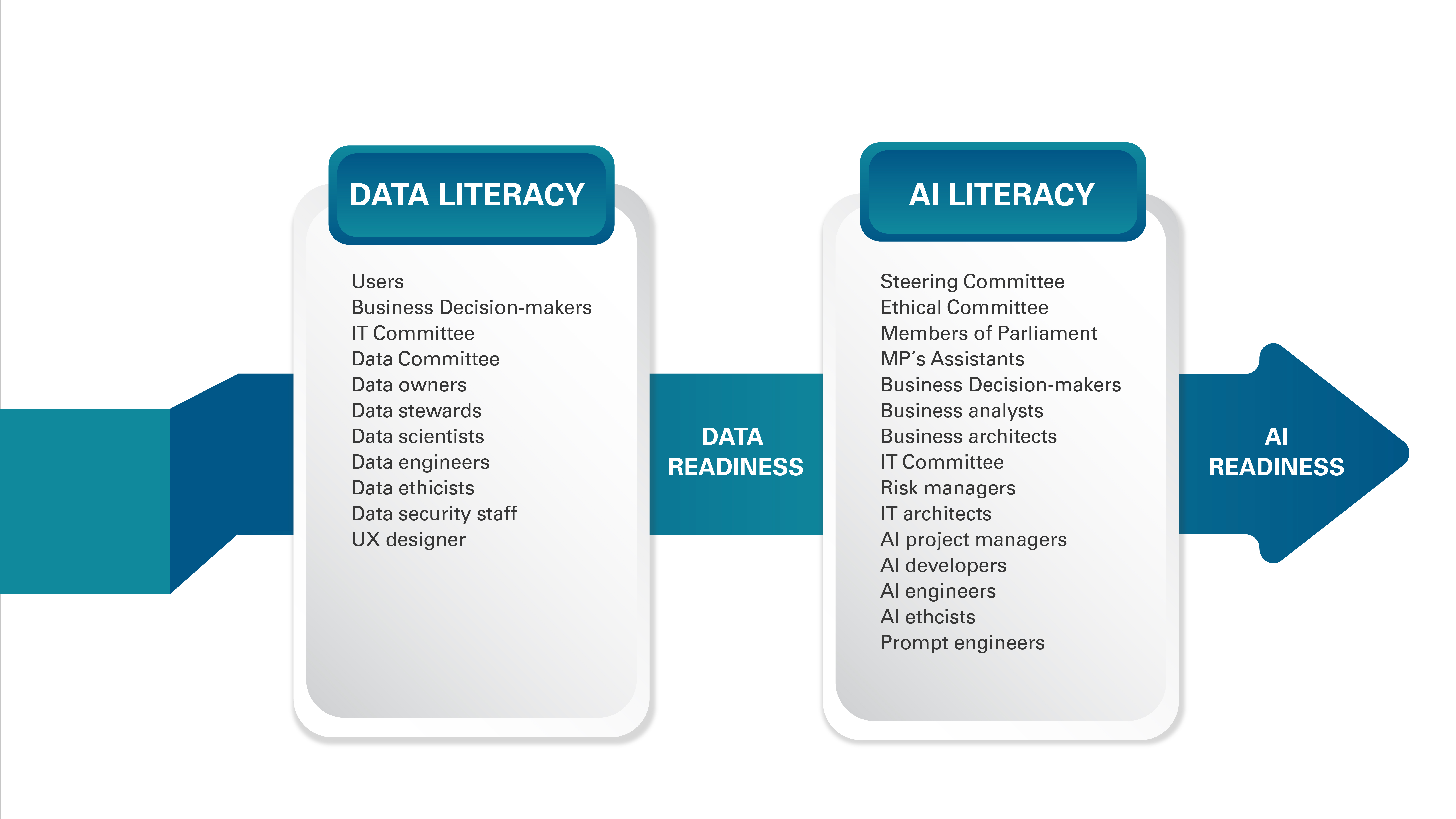
The figure above emphasizes the importance of starting a data literacy programme before working with AI, and why it is important that parliaments have a plan to ensure good levels of AI literacy.
In addition, the emergence of generative AI takes the technology to the end user and gives them the power to harness it in their work. For this reason, it is important for staff and MPs to understand the basic tenets of data literacy and AI literacy, including the risks and downsides, before they utilize such tools in parliament.
Data literacy in an AI context
By establishing a training programme and building a solid foundation in data management, parliaments can harness the full potential of their data assets to support evidence-based decision-making, foster public trust and uphold democratic principles.
Developing AI literacy
AI literacy is crucial in parliaments because it enables MPs, decision makers and staff to make informed choices about AI adoption, shape appropriate policies and regulations, and effectively oversee AI-driven initiatives.
Having a well-trained workforce that is familiar with at least the basic tenets of AI will help parliament to both leverage the opportunities AI presents for enhancing parliamentary functions and mitigate the potential risks that can occur.
For further guidance on developing AI literacy in parliaments, refer to the sub-guideline Training for data literacy and AI literacy: Developing AI literacy.

The Guidelines for AI in parliaments are published by the IPU in collaboration with the Parliamentary Data Science Hub in the IPU’s Centre for Innovation in Parliament. This work is licensed under a Creative Commons Attribution-NonCommercial-ShareAlike 4.0 International licence. It may be freely shared and reused with acknowledgement of the IPU. For more information about the IPU’s work on artificial intelligence, please visit www.ipu.org/AI or contact innovation ipu [dot] org.
About the guidelines | The role of AI in parliaments | Introducing AI applications | Inter-parliamentary cooperation for AI | Strategic actions towards AI governance | Risks and challenges for parliaments | Generic risks and biases | Ethical principles | Risk management | Alignment with national and international AI frameworks and standards | Project portfolio management | Data governance | Systems development | Security management | Training for Data Literacy and AI Literacy | Glossary of terms