Impact
The IPU facilitates parliamentary diplomacy and empowers parliaments and parliamentarians to promote peace, democracy and sustainable development around the world.


The quarterly electronic bulletin from the Centre for Innovation in Parliament
In this issue, we explore how the Parliament of India is using AI to make legislative proceedings accessible across all 22 of its scheduled languages. We also report on the in-person meeting of the Centre for Innovation in Parliament’s (CIP) Parliamentary Data Science Hub in Rome, where 23 parliaments took stock of AI implementation and found that governance, capacity and culture were struggling to keep pace with the rapid evolution of the technology. In addition, we look at how the National Assembly of Mauritius is building an intelligent parliament by putting governance frameworks in place before deploying technology. We also examine the comprehensive suite of AI-powered platforms deployed by the Shura Council of Bahrain, from the Shura 360 digital hub to the Intelligent Hansard System and the Legislative Tracker Platform. Finally, we share updates from across the hub network, covering digital accessibility, procurement in thin vendor markets, data governance, and AI-assisted transcription.
We are posting examples of innovation in parliament on Twitter using the hashtags #innovation #parliament. Please join us in using these hashtags, or send us good examples that we can share!
Do you have an example of innovative parliamentary working methods to share in the Innovation Tracker? Tell us about it via this online form or by e-mail to [email protected].


The Transforming Parliaments webinar Digital accessibility at the European Parliament, held on 11 June 2026, explored how the European Parliament ensures inclusive digital experiences across its public websites, mobile applications, intranets and electronic documents. Presentations from the European Parliament’s Solution Design and Quality Assurance Unit – which sits within the Directorate-General for Information Technologies and Cybersecurity (DG ITEC) – covered the following topics: the core principles of digital accessibility; the European Union legislative landscape, including the Web Accessibility Directive and the European Accessibility Act; the Digital Accessibility Competence Centre and the Digital Accessibility Officer Network; and accessible procurement, including the Voluntary Product Accessibility Template. The webinar also featured a live screen reader demonstration.
The recording and the key takeaways document are available on the event page. The webinar drew 131 participants representing 38 parliaments across Africa, the Americas, Asia-Pacific and Europe.
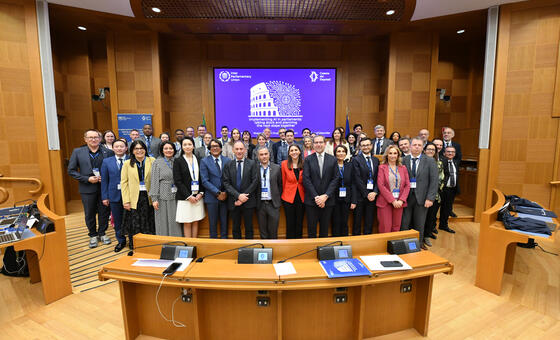
The Parliamentary Data Science Hub held its 2026 in-person meeting at the Chamber of Deputies of Italy in Rome on 13–15 May, co-organized with the CIP and the Chamber of Deputies of Brazil. A full report on this meeting is included in this issue of the Innovation Tracker.
The Pacific Regional Hub has launched a new community of practice (CoP) on digital transformation. The first session, a webinar entitled Procurement in thin vendor markets, was held in April 2026 and examined procurement practices that impact digital transformation efforts. The findings that emerged were then paired with a proposed action for the CoP:
Technical staff are currently excluded at the stages where their input is most valuable: writing specifications, assessing vendor capability and evaluating proposals. By the time ICT is consulted, key decisions have already been made, often by administrative staff without the technical background to assess digital fit. Participants proposed a procurement initiation checklist requiring ICT sign-off at the specification stage.
Most parliamentary procurement frameworks define “local” as in-country registration. For small Pacific nations, this reduces the qualified vendor pool to near zero for specialist digital work. Regional suppliers with proven Pacific experience are disqualified on registration grounds alone. Participants proposed mapping the exact regulatory language used to define “local” vendors across Pacific jurisdictions, and identifying where flexibility already exists and can be adopted.
Vendor relationships remain person-dependent rather than institutionalized, with market knowledge lost when staff move on. Participants proposed a peer-maintained vendor intelligence register to retain this knowledge across the network.
On 6 May 2026, the Southern Africa Regional Hub held a knowledge exchange webinar on the AI journey of the National Assembly of Mauritius, moderated by Mr. Jacob Odada of the Pan-African Parliament.
The session focused on how the National Assembly is deploying AI to enhance its Hansard production process, in particular by accelerating voice-to-text transcription and reorienting staff time towards quality control of the final output. This approach has been observed in other parliaments, including the Estonian Parliament, as reported on in Innovation Tracker #16.
The webinar was attended by parliamentary staff from Ghana, Lesotho, Madagascar, Malawi, Mauritius, Namibia, Seychelles, South Africa and Zambia. The full story on the AI journey of the National Assembly of Mauritius can be found elsewhere in this issue of the Innovation Tracker.